Wednesday, 13 March 2019

LESSONS LEARNED ON LISTENING TO YOUR OWN ADVICE!


How many times have you given someone a great piece of advice but failed to act upon it yourself? This seems to be a common flaw amongst teachers, including myself.

Take for instance, if you’re not well. One of my responsibilities as Deputy Headteacher is staff welfare.  I have conversations with staff on a regular basis about their well-being and often find myself saying 'your health comes first'. When it comes to sending staff home who are not well enough to be in work, the conversation tends to go ‘but I need to teach my exam groups’. Whilst it’s admirable that we put the needs of our students first, we sometimes need to be kinder to ourselves. I found that out myself last week when I tried to force myself to work through a nasty migraine only to be sent home after a rather embarrassing turn in the canteen.

A big buzz word in education at the moment is resilience. As leaders and teachers, we often have to put on a brave face and just get on with things. However, I do wonder if that sometimes sends out the wrong message, especially when it comes to illness. If I force myself into school when I am clearly not well enough, am I sending a message to other staff that they should do the same?

Mental health is a big talking point in the profession at the moment and rightly so, but we should not lose sight of physical health. I wonder how many teachers have put off going to the doctors because they can’t get an after school appointment or simply can’t fit it into a busy week? Moreover, how many teachers have put their physical symptoms down to the job? Or indeed doctors? 

I have great admiration for those working in the medical profession. However, I would urge anyone who has any long term symptoms to follow them up. For years, I put agonising headaches down to stress. I repeatedly went to the doctors only to be told that my headaches were due to tension and that I should try and find ways to relax. Even when I pointed out a small lump on my forehead, I was told that it was the shape of my skull. I put off going back to the doctors for fear of being labeled a hypochondriac. It took a visit to a sports masseur to convince me to go back. She took one look at the lump on my head and said I needed to insist on having a scan. Turns out I had a tumor growing in my skull and needed surgery to have it removed. Fortunately, it was benign but it was certainly a reality check for me. As part of my surgery, I had a section of my skull removed and a metal plate inserted. As if that wasn’t bad enough, we had the Ofsted call three days before my op. If ever there was a time to say you need Ofsted like a hole in the head, it was then!

Back to not listening to my own advice. Three weeks after my surgery, I went back to work. Looking back, I really wasn’t ready. My school certainly didn’t put any pressure on me to go back but once again, the guilt at missing lessons with my exam groups kicked in. Even though I had a genuine reason for being off work, I found it hard not to worry about my growing workload and the extra pressure I was putting on my colleagues.

So what lessons have I learned?

Health has to come first. My sister who is also a teacher was diagnosed with breast cancer at the age of 32. She too was told that her tiredness was most likely down to work and nearly didn’t go back for a second checkup.

    Listen to your body.

    Don’t put off medical appointments and   that includes the embarrassing ones!
   
      Don’t try to be a hero!


Sunday, 3 March 2019

Lessons learned teaching the new spec Geography GCSE


Faced with a new specification and grading system, I really had no clue how my students would fare in their Geography GCSE last summer.  If their faces were anything to go by after the exam, I wasn’t feeling too hopeful. That is until I logged onto Twitter and read some of the student comments! If all else fails, we have a future generation of comedians in the making. Here are a few of my favourite post exam tweets:


In true geography teacher style, I happened to be in China last summer when the results came out. ‘Lesson planning on location’ as I like to call it! I nervously logged onto e-AQA at Shanghai airport. Having just spent a couple of weeks in geography heaven, I did fear my geography high was about to come crashing down. As Deputy Headteacher, I inherited some of the more ‘challenging’ students in my group. I don’t mind admitting that I frequently had flashbacks to my NQT days. Teaching global atmospheric circulation for the first time was a particularly low moment in my teaching career to date!

All of the leadership team at my school teach exam groups, including the Headteacher. Your credibility as a leader hangs very much in the balance when it comes to your own results. You can hardly hold others to account if your own results don’t stack up. Thankfully, I was pretty happy with my results overall. There’s always one or two students who, despite working their socks off, don’t quite pull off the grade you hoped for in the exam. However, my predictions were fairly accurate and I had a positive value added so I couldn't complain.  The enhanced results analysis on e-AQA showed a very positive picture for our department too.  We have a fantastic team of geographers but, like many schools, we simply ran out of time trying to teach the new specification. Pretty much the whole of the Economic Activity unit had been self-taught via a work booklet. I think I broke a teaching world record covering the whole topic in sub two hours. If I achieve nothing else in life, I have found an instant cure for insomnia!

So what lessons have I learned along the way?

Less is more When I first started teaching the specification, I was completely overwhelmed by the volume of content in the affiliated textbooks. Teaching mixed ability groups has proven especially challenging. No amount of differentiation can fully accommodate for students whose predicted grades range from a 2 to a 9. I have always ‘taught to the top’ but with increasing A level content in the new spec, I felt that I was losing my weaker students. Moreover, sticking to the recommended teaching hours was like running against a category 5 tropical storm!

I decided to start planning my lessons following the content in the CPG revision guide. To challenge my high ability students, I encouraged them to work independently using the textbooks. However, I quickly realised that this was not necessarily doing them any favours. How can you possibly condense a 4-page case study in a textbook into a one-page answer in an exam booklet? I found that my higher ability students were really struggling to answer 9 mark questions. Typically, they wanted to write everything they knew about the case study. I decided to focus less on content and more on how to structure answers. Now all students use the CPG guide as a foundation but I challenge the top end by encouraging them to use more complex terminology and place specific information. I still dip into textbooks and find them a great source of information for my own planning. I tend to mix and match rather than rely on one textbook to teach from.

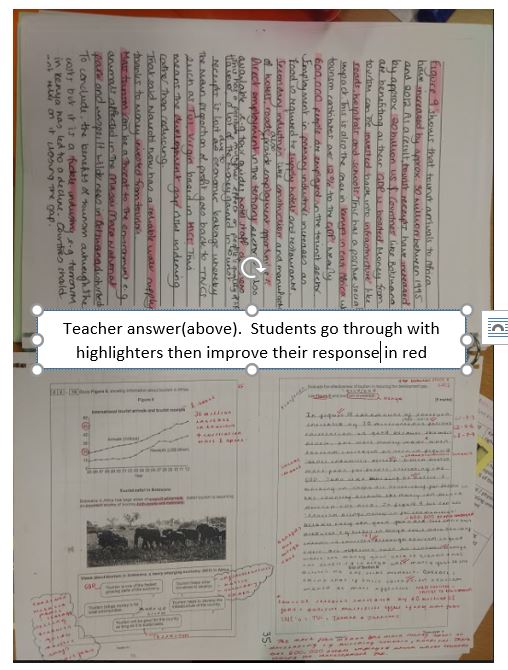
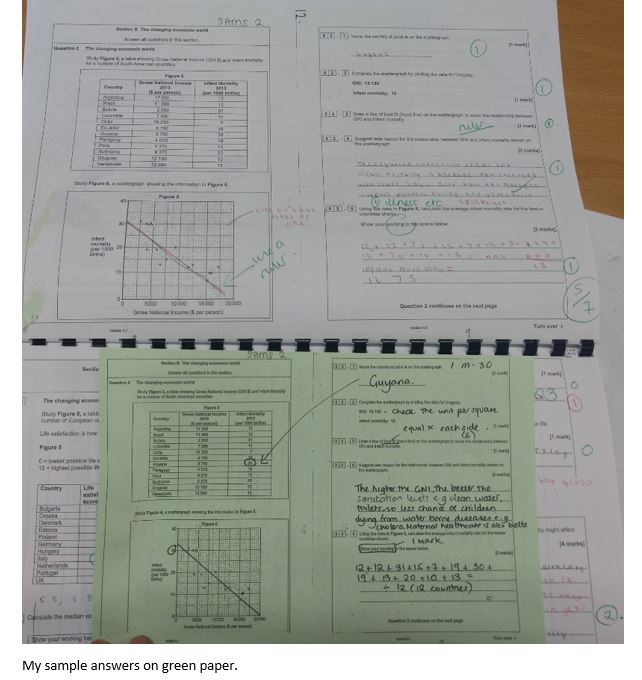
I have always created my own model answers which I type up and photocopy. Increasingly, I found myself saying ‘you won’t be able to write this much in the exam’. I therefore decided to start handwriting model answers at the same time as my students. Not only is this time saving as a teacher but it also gives students a realistic idea of what is possible in the given time. If I can’t condense the content into a Level 3 answer, how can my students? I use a camera app on my laptop to display my answer which I later photocopy for them. Students are expected make notes from my verbal feedback and improve their answers in red pen. I make it pretty clear that I won’t be writing detailed feedback on their answers and issue sanctions to students who don’t red pen their work with improvements.


It’s all about the spec! I’m going to confess that in my first few years of teaching, I didn’t really pay much attention to the exam specifications. I rather naively relied on the schemes of work provided by the department and the textbooks. Now, I make reference to the specification in every lesson. All students are provided with a copy of the specification for each unit of work. I drill it into them that they have to know the meaning of every single word in the specification. I have moved away from using exercise books and instead produce work booklets that have headings from the specification alongside exam questions from the specimen papers. Initially, I gave them a separate booklet of sample questions but I now interleave questions so students can see the link between the wording in the spec and the exam questions. This way, there are no nasty shocks when words like agribusiness or physical processes come up in the exam. As a teacher, I can easily spot work that students need to catch up on. It also helps to reduce planning in the long term as all of the worksheets and exam questions are pre-printed in the booklet. 

Initially, the work booklets went down like marmite with my students. For the 'lovers', it has really helped them to organise their notes especially since there are no loose worksheets. Even the initial ‘haters’ now see the benefit of having everything in one booklet to revise from. I appreciate that this approach wouldn't appeal to all teachers but it works for me. Whist they initially take quite a lot of time to produce, it pays off in the long term. I tend to set notes as homework and concentrate on exam questions in the lessons. 

I start all of my lessons with literacy activities using the words from the spec e.g. bingo, A-Z, heads and tails. When deconstructing exam questions, I make students look at the wording in the specification to see the correlation. I have found that the biggest barrier to students is the wording of exam questions rather than a lack of knowledge. The 'less is more approach' to delivering content allows me to dedicate more time to covering academic language. Repetition is key here. You want students to become as familiar with words like formation and landforms, as they are with the everyday language that they use. 


Teach from the mark schemes I have confessed to ditching the textbooks and teaching from the CPG guides which may horrify some geography teachers. However, I also base my planning on sample papers and mark schemes. How often have you gone through mark schemes and discovered content that you have never come across in a textbook? The indicative content in last summer’s exam papers is sometimes far better than the content in the textbooks. If you want to do exam practice but haven’t time to mark 30+ answers, try some simple tasks like:

Give students the mark scheme. Use the AQA command word list and specification to write an exam question. I have done this as a competition to see which students can get the closest to the actual question

Blank out some of the words in the indicative content and provide a word grid at the bottom. Students to guess the missing word

Use the indicative content to write the answer. It’s a skill in itself condensing the indicative content into a one-page answer


I have also put the sample questions and mark schemes from each topic into a PPT that I share with students via our online homework platform. The PPT has an exam question on one slide followed by the mark  scheme on the next slide. I encourage students to work their way through the PPT as part of their revision by tackling a few questions at a time. Whilst I see the benefit of flashcards and mind-maps, I firmly believe that the key to success is practising exam questions under timed conditions. I dedicate a lot of my lesson time to breaking down exam questions by looking at each individual word and planning how to answer it using a variety of templates and structure strips.


Don’t reinvent the wheel…unless it’s quicker There are some amazing online resources to dip into, not least the AQA Geography Facebook group and Schoology resources. However, it comes with a warning. If it takes you longer to find the resource than to make your own, is it really time saving? That said, the community of geographers that contribute to online forums should be commended. Quite possibly some of the best CPD you will get is from other teachers sharing their ideas on social media.

Be a teacher on tour! Geek is chic in my lessons! I make no apology for being a complete geography geek and play up to the reputation of being a bit crazy. My travel partners are well used to filming me ‘on location’. Whilst my students take the mickey out of me for it, I think when they look back in years to come they will remember my ‘Miss Thom in her geography heaven’ moments.


When the going gets tough, get creative! I will be the first to admit that my lessons have started to become like an exam factory. Fortunately, our school took the move to deliver GSCEs over three years. This has enabled me to be creative again and to have some rest bite from teaching the heavy content. My favourite activity is to put out paper, glue and scissors and simply get students to summarise the topic by making a model that they have to label with key terms. Not only is this a great way to consolidate learning but you have some pretty impressive models to display during open evenings. Moreover, there are times when you simply don’t have the capacity to mark more written work but don’t want to compromise student progress.

If doubt, turn to You Tube! I can't imagine teaching now without using video clips to bring the topic alive. There are so many fantastic clips and documentaries to enrich lessons. Online forums are a great way to spread the work about a useful clip. More recently, I discovered the 'Time for Geography' website. I love the fact that the clips are delivered by students and have used these to generate discussions about studying geography at university.

If I don't feel very confident on a particular aspect of the specification, I show a video clip rather than try to blag my way through it. I certainly had to do this with global atmospheric circulation. After the third time of teaching it, I think I have finally grasped it!

Finally, I would like to thank all of the geography teachers who share their ideas and resources on Facebook and Twitter. Not only have you reassured me but you have also inspired me along the way.

Tuesday, 12 February 2019

LESSONS LEARNED ON STAFF WELFARE


LESSONS LEARNED ON STAFF WELFARE
Talk to anyone who works in education, regardless of their role or position and it won’t take long for workload or well-being to come up in the conversation. Increasing levels of accountability mean that leaders and teachers are under more and more pressure to get results. When I have dared to bring up the issue of workload to some of my non teacher friends, I have been instantly reminded how we ‘have it lucky’ and ‘don’t know we’re born’. I have long stopped trying to defend my profession. To the outside eye, we have on average 13 weeks paid holiday a year, relative job security and a decent pension so why are we moaning? Having worked in the public sector myself, I am fully aware of the pressures that come with other professions and I do appreciate that I am very fortunate to have a job that allows me to travel the world during my holidays. Yes, I have been reminded of that many a time! However, with more and more teachers leaving the profession and a recruitment crisis, we can’t afford to dismiss the fact that teaching is a bloody tough job!
One of my responsibilities as Deputy Headteacher is staff welfare. When I first joined my school over five years ago, I wouldn’t say that this accounted for much of my working week. Increasingly, it is becoming a significant part of my role. 

It is little wonder that staff are feeling the strain in light of changes to exam specifications, increasing accountability and, for us as a school, a less than favorable Ofsted inspection. As a Senior Leader, I am well aware that we have a responsibility to ensure that staff workload is manageable. We have taken measures to hold termly staff welfare meetings and to conduct staff surveys in order to identify and address some of the issues that our staff are facing. I strongly believe in staff having a voice and that we all need a platform to vent out our frustrations.  Whilst getting things off your chest is cathartic, we also need to be realistic that often it is the education system at fault rather than the school. 

Take for instance, monitoring and evaluation. I am fortunate to network with lots of senior leaders from local schools, all of whom carry out regular learning walks and book trawls. Indeed, if you were to rank the frequency of M&E in local schools, we would come out pretty rosy on the staff welfare front. That’s not to say it’s not a contentious issue in our school. No doubt, monitoring and evaluation would be shelved in Room 101 by most teachers…and being slightly controversial here, by some leaders too. Done properly, it’s a time consuming process for all parties involved.

That said, I do think M&E has its place when conducted in the right way. Some of the best conversations I’ve had with students have been during student voice meetings. Young people can be very perceptive when it comes to their learning and we can all take something from their feedback. But the nicest moments are when you try to unpick why it is they love a particular subject. More often than not, their response is simply because of the teacher. We always aim to give staff feedback from M&E and there’s nothing nicer than telling a member of staff that a student really values what they’re doing.

So, back to lessons learned for teachers and leaders.

I saw a great quote recently. It read ‘Stop trying to make everyone happy, you’re not tequila’. This is certainly the case in a school context! We will never please all students, all parents and all staff. There has to come a point when simply doing our best is good enough. In terms of staff welfare, we have revised our school marking policy, streamlined our reporting and performance management system and allocated more CPD time to departments. Will this make everyone happy? No because marking, reporting and performance management still have to be done. I was fortunate to sit on the DfE’s Marking Review Group so I’m a big advocate of cutting down unnecessary marking. That said, could I rely solely on verbal, self and peer marking? No, because I still believe students deserve some form of personalised feedback for their efforts. I’ve tried marking codes, pre-printed marking sheets and the use of model answers to speed up the process. In terms of marking assessments such as mocks, I have yet to find a quick fix.

What we can try and do as a leadership team is to look at our school calendar and take into consideration pressure points. And that’s another contentious issues – the calendar! We have consulted staff on the calendar and taken on board their feedback. No matter how much you try and factor in the lessons learned and make the necessary changes, you can’t be tequila! One change in the calendar invariably opens up a whole new set of issues.

So, what steps can be done to manage workload? Here’s a few that we have tried at Plantsbrook:

School marking policy – we have a red pen policy whereby students self and peer check their work and respond to any teacher feedback. We do not expect to see extended written comments by the teacher and have moved away from the What Worked Well / Even Better If approach. We encourage the use of question codes and live marking where applicable. 

Performance Management – We have moved away from three commensurate targets to two targets that are commensurate and one target that is personal. Historically, staff had to come up with a list of actions for each target that they would evidence throughout the year. To streamline the process, we produced a list of sample actions linked to job specifications and Teacher Standards. We have advised staff to choose up to three that they feel are their areas of development. We do not expect staff to upload any evidence or write lengthy comments justifying how they have met their objectives. As well as saving time, the hope is that this will result in more professional dialogue during review meetings and a feeling of professional trust.

  Reporting – we have streamlined our reporting process using drop down judgements for classwork, behaviour and homework etc. Written comments take the form of two targets selected from a pre populated comment bank. This has significantly reduced the amount of time writing and proof reading reports.

  
  CPD – after each training session, staff complete an online evaluation. Feedback suggested that staff would like more time to work with their departments on curriculum planning. However, a shift from whole school training to subject training risked putting extra pressure on Subject Leaders. To limit this, a menu of suggested CPD activities was shared, along with sample resources that Subject Leaders could select from. 


In terms of well-being, staff have been proactive in arranging events that bring everyone together. This has included a staff curling competition, yoga and bake offs. More recently, one of our Academic Coaches organised a Secret Saint activity. Staff who volunteered to take part were allocated someone to do random acts of kindness for. The response was overwhelmingly positive and a real morale booster. Gestures such as a chocolate treat for breaktime and pamper kits for the weekend were truly well received. Lots of staff took to Twitter to share their secret surprises.

When it comes to my own wellbeing, I have learned to accept that I cannot be a perfectionist. Here are a few tips that have helped restore my work life balance.

Go back to basics – don’t be afraid to use textbooks, teach students how to make notes effectively and devote lesson time to deconstructing exam questions – the best lessons don’t have to be all singing, all dancing. Quite often, it’s your personality that makes lessons memorable. Smile, laugh or refer to your own experiences. My A Level geography teacher didn’t ‘edutain us’ but his passion for the subject certainly inspired me!


  Less is more - As a geography teacher, I have realised that the volume of content that I was teaching was overwhelming my students and giving me grey hairs trying to cram it into two years. When I looked through the sample papers, I realised that I was teaching in way too much depth. I now restrict content and focus more on the academic language that students need to know in order to understand what the question is asking of them.

 Hand write model answers at the same time as the students. Not only is this time saving but it gives students a realistic idea of what can be produced in the given time. Make use of a visualiser or photocopy your answer for the next lesson. Get students to improve their work prior to handing it in and you immediately cut down on marking.


  Be a radiator not a drainer! We all need to offload but remember the importance of having a laugh too! And this applies to out of school. Cut down the teacher chat and simply switch off.

    Have a night / day off. Give yourself one night when you don’t take any work home and don’t feel guilty for it. Go to the pub for dinner, spend quality time with your family or simply have a soak in the bath. Doing a ‘feel good’ activity works wonders. For me, it’s a military bootcamp though I accept that this would be some people’s idea of hell after a day at work.

I have come to accept that there is no magic wand when it comes to addressing staff wellbeing. Quite often external factors are at play and sometimes it’s just offering an ear or a shoulder to cry on. What we can do is to look out for each other and take good care of ourselves. Sometimes that means shifting our own mindsets and practices and not letting guilt overcome us.


Friday, 18 January 2019

LESSONS LEARNED - THE JOURNEY TO SENIOR LEADERSHIP


'A Leader is one who knows the way, goes the way and shows the way' John C. Maxwell

As part of my performance management appraisal last year, my Headteacher suggested that I write a blog. As a Deputy Headteacher, my responsibilities include Teaching and Learning, CPD and staff welfare. I have considerable experience of delivering CPD at a regional and national level so it makes sense to share my experiences and expertise in some kind of blog. Like the rest of our Leadership team, I have a Twitter account and find it an invaluable source of CPD, not to mention a great way to keep up to date with ‘what’s what’ in education. 


However, I have often wondered how any teacher or senior leader finds the time to blog on top of their day job whilst at the same time having a life! And I am a big believer in having a life. I am also uncomfortable with self-promotion. I am not an expert on education nor do I claim to have all of the answers but what I can do is share what I have learnt…warts and all!  


I was fortunate enough to be part of the DfE’s Marking Policy Review Group which ironically came about as I wrote a one off blog which you can read here https://teaching.blog.gov.uk/author/emma-thom/

This proved to be a great opportunity, not least because I was able to represent the views of many of my colleagues but also as a vehicle to drive change in my own school.

So on reflection, taking time out of a busy day to jot down some thoughts that could benefit fellow teachers or leaders is not such as bad idea after all.


I recently facilitated a course to aspiring senior leaders and it made me reflect on my own teaching career and my step up to senior leadership. I should note that I have never actually attended a senior leadership course myself and don’t hold any leadership accreditations. Nor I might add am I fiercely ambitious. It was certainly never part of my career plan to become a Deputy Headteacher and I still have those out of body moments when you look down on yourself in meetings and think, how on Earth did this happen?


I put my career path down to my personality traits. It is somewhat of a family joke that I get bored easily, struggle to stay on one task and find it very hard to sit still for a prolonged period of time. Senior leadership therefore suits me perfectly because, as any senior leader will tell you, being able to juggle comes with the territory. My career ambition was to become a Head of Geography which was not on the cards at my first school so I applied for a role at a very successful, local comprehensive. During my lesson observation, my memory stick froze, the screen went blank and it all went a bit Pete Tong! Consequently, I was told that I would not be going through to the interview stage. At the time, this experience was a huge blow to my confidence but it did give me the incentive to prove my worth. As we regularly tell our students, FAIL means First Attempt in Learning and I went on to become an Advanced Skills Teacher (AST). This opened the door for me to coach staff across all subjects and to deliver training to local schools which ultimately got me to where I am today.


Having started to get itchy feet at my first school, I started looking for other AST roles. At the time, schools only wanted ASTs in core subjects which was my next barrier. I spotted a job advertised at a local, inner city school for a Head of Geography. On the off chance, I contacted the Headteacher and asked if she would consider taking me on as an AST and Head of Geography. The school had had no suitable applicants for the post and once again, I like to think fate was at play as I got the job. I spent four very happy years at that school and I think it made me the teacher that I am today. Many of the students were what we might politely call ‘challenging’ but helping to turn young people’s lives around was the best reward and, if you’ve ever worked in a tough school, you’ll know that there is something very special about the camaraderie amongst the staff. My advice to anyone reading this is to take a chance. After a couple of years, an internal vacancy for an Assistant Headteacher came up. I knew it had someone else’s name on it but I decided to apply for the interview experience. Luckily, the Headteacher saw potential in me and offered me a secondment onto the Leadership Team. I would advise any aspiring leader to snap up the opportunity to do a secondment. Not only does it give you a glimpse into the role but it equips you with a new set of skills and expertise that will help you to stand out in the shortlisting process.


And so to my current role as Deputy Headteacher. I had been an Assistant Headteacher for two years and was starting to think I might like to be a Deputy Headteacher one day. I remember walking past Plantsbrook School and telling a friend that if I were to be a Deputy Headteacher, I would like it to be there. I didn’t really know a lot about the school other than I had heard that it was a happy place to work…and that’s my second piece of advice. I have based every decision on whether to accept a job on whether I could see myself fitting into the team. I have withdrawn from interviews because I didn’t get a feel for the staff that I would be working with. I am a big believer in following your gut instinct, especially when you have to make a decision about a job there and then. When the going gets tough (which it will), you have to know that you have colleagues that you can turn to and, most importantly, make you laugh. I have worked in three schools and my gut instinct has never let me down. I have worked with some amazing colleagues who count as some of my closest friends.


In another twist of fate, a role was advertised for a Deputy Headteacher at Plantsbrook School shortly afterwards. Having only two years experience as an Assistant Headteacher, I didn’t fancy my chances of getting shortlisted. I had also heard on the teaching grapevine that there were internal candidates. In my favour, I had delivered a Saturday morning training session as part of a local consortium network to some of the Plantsbrook staff and had received good feedback. At the time, I remember regretting signing up to deliver a session on a Saturday morning but it proved to be one of the best things I did. When my job application landed on my Headteacher’s desk, she took a chance on me and shortlisted me. The interview was the toughest process I have ever been through. I got shortlisted to the second day along with two other internal candidates. For me, just getting through to the second day was a personal achievement. When called back into the interview room to get the outcome, I had to ask the Chair of Governors to repeat himself in case I had heard him incorrectly. The decision had been made to appoint all three of us. The morale of the story….never be put off when there are internal candidates as you can offer a fresh pair of eyes.


If I knew now what the job entailed, I would probably never have put an application in. Not because I don’t love my job but because it has been such a steep learning curve. In all honesty, I don’t think I would have ever been ready for it. There are just some things that you have to learn on the job! However, if you have potential and you can show that in an interview, then go for it! Don’t let a lack of experience prevent you from taking the plunge.


Thanks for reading.

Emma


LESSONS LEARNED ON LOCKDOWN

When the coronavirus lockdown was announced, I wrote a long list of things to do in order to fill my time. I have always loved writing an...